Twenty years from now you will be more disappointed by the things that you didn't do than by the ones you did do. So throw off the bowlines. Sail away from the safe harbor. Catch the trade winds in your sails. Explore. Dream. Discover. (Mark Twain)

Thursday, July 26, 2018

Suzhou

While in Shanghai, we wanted to spend one day in one of the water towns nearby. But which one to choose? I was searching the internet in order to decide whether I wanna see the most authentic one, the most famous one, the most touristic one, the least touristic one, the most romantic one etc., but every review had another winner. I was really confused. In the end, aren't they all the same?  Probably kind of. 

In the end we decided to go to Suzhou, which - although is not one of the water towns - it's known for its canals, bridges and classical gardens. It was one of China’s cultural and historical capitals with its 2500 years of history. It was as well an important commercial center of China, but also an economic one and one of the largest cities in the world. Today it's one of the most popular tourists site in China famous for its over 60 Classical Gardens, out of which 9 were added to the list of the UNESCO World Heritage Sites. Most of these gardens were built by aristocrats, scholars and rich businessmen.


In my naivety I thought that maybe after a visit in Suzhou, we could still spend the afternoon in one of the nearby water towns. Although we left the hotel in the morning, the journey to the train station, the time we spent on buying tickets and then the journey by train to Suzhou made us arrive to our destination around noon. Still I thought we had plenty of time to see Suzhou's main attractions, which in the end wasn't really possible. As everything in China, Suzhou only seemed small, but in the end distances we had to cover were quite big.

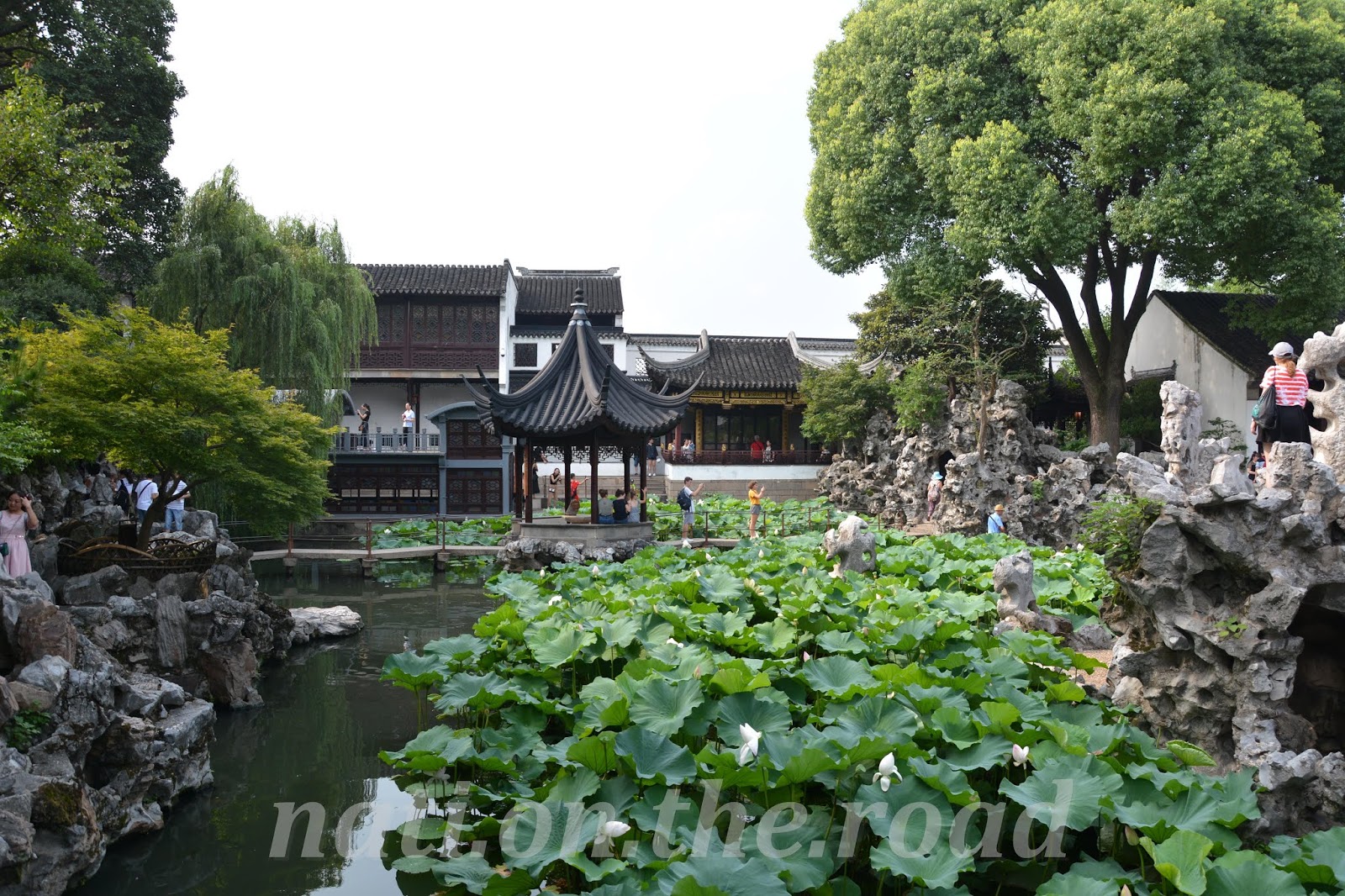
We started the sightseeing with the most famous garden - Humble Administrator Garden, which is also Suzhou's largest garden. It was created in 1509 during the Ming Dynasty. The entrance ticket costed around 10 euros. The garden was really big - with ponds, bridges, pavilions, rockeries, trees and of course zillion of tourists ;-) it was also not very easy to visit it with the stroller, but even this limited visit was very pleasant and gave us an idea about Chinese gardens.


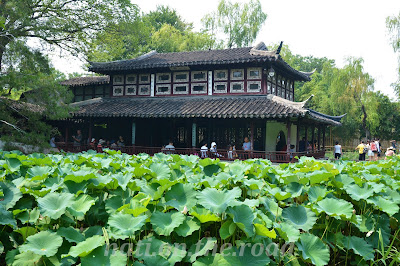


Next place to visit was of course another garden. We chose Lion Forest Garden, which was located very close to the Humble Administrator Garden and which is one of the Classical Gardens of Suzhou on the UNESCO list. It is also one of the "Top 4 Famous Gardens in Suzhou" It was built in the fourteenth century and it is the oldest of Suzhou gardens. It was smaller than the previous one, but very interesting because of its rock formations - something special among Suzhou's gardens. Because of these rock formations is also called the Kingdom of Rockeries. Apart from rocks, it had richly ornamental pavilions and towers in different styles. 


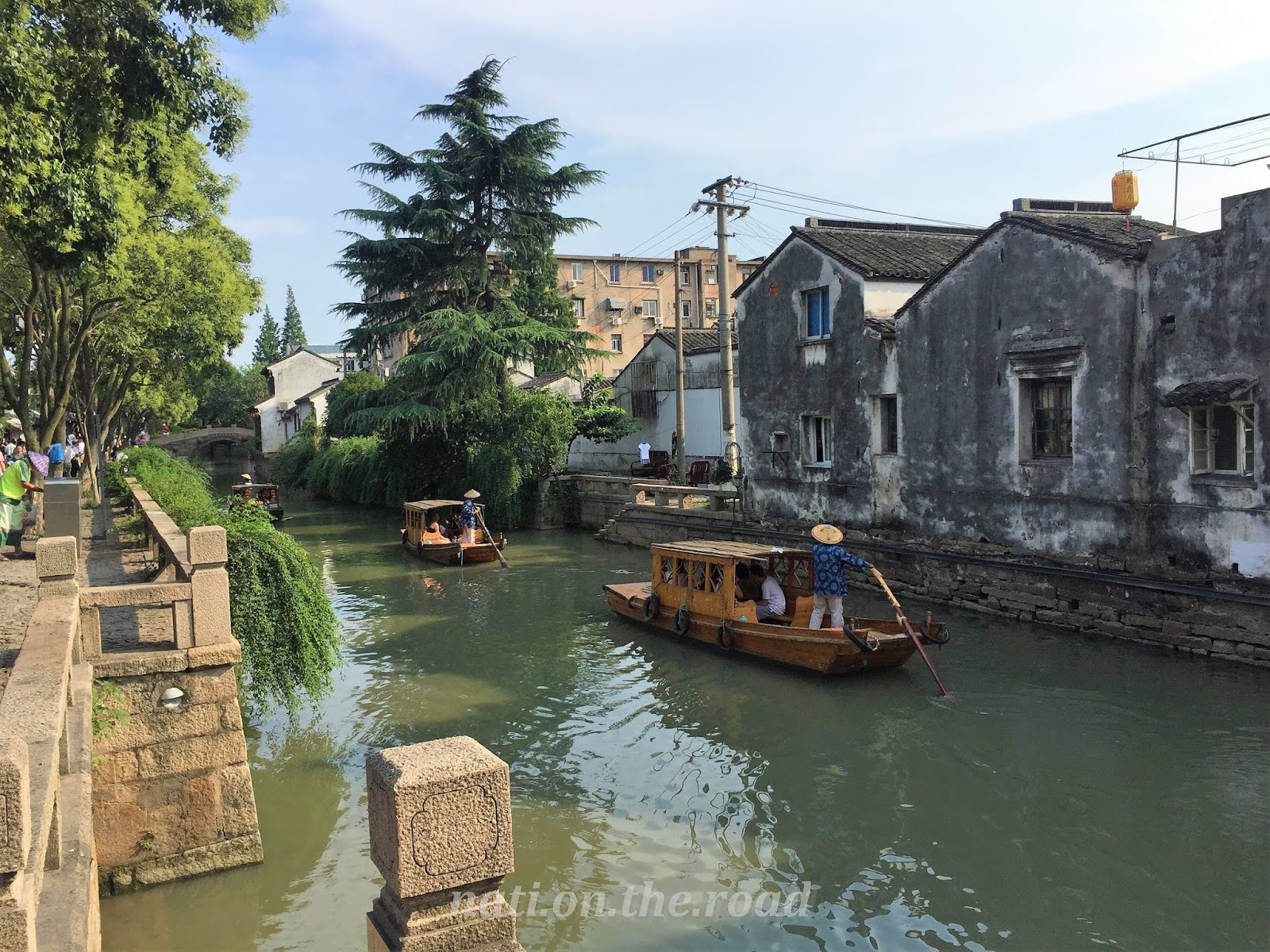
We continued our walk till the most famous street of Suzhou - Pingjiang Lu street, which is parallel to the Pingjiang River. The street is also the longest in Suzhou with its 1,606 meters. Down the canal several tourists were enjoying cruises along the river - but since we had a baby stroller, we didn't decide to rent a boat and we continued our walk on the street. 
I loved it! Traditional old architecture was something I was missing in Shanghai. This part of the city was apparently nearly not changed for around 800 years. For many years the Pingjiang Lu street was a centre of Suzhou 's cultural life.



Time was running out, we did not even manage to see half of the attractions on our list, when we slowly had to start heading back to Shanghai. But there was one more place, which I very much wanted to see - Shangtang street. Shantang Street, also called Seven-mile Shantang, is an ancient street block built in the 9th century. Many say it is the “Miniature of Old Suzhou and Window of Wu Culture” because it is reflecting so perfectly the ancient Suzhou city. And because of having the advantageous location of both convenient land and water transportation, Shantang Street was once one of the best well-developed street blocks in China.


As it seemed to be quite far, we took Didi to get there. It turned out quite crowded, but a very picturesque place! We took a few photos from the Tonggui Bridge, which was also a great place to admire the Shangtang Street from, and after that we had to rush to the train station. After this ultra intense sightseeing we took the bullet train and came back to Shanghai. We had a lesson today - nothing in China is little and if we wanted to visit places, we basically had to start sightseeing as early as possible.

Wednesday, July 25, 2018

Shanghai

I visited most of Asian countries, but one big country was still missing in my portfolio - the biggest and one of the oldest Asian civilizations - China. I cannot even say why for so long I wasn't willing to go there and was choosing other Asian countries.

As this summer my daughter was turning two, which meant from now on we would need to pay full price of the ticket, it was the last opportunity to go to another continent without paying for her ticket. Since Marijn was already a few times in China and he agreed to return there, because he knew I very much wanted to go to China, I decided to plan this trip in a way to see places he hasn't seen so far. Which meant skipping Beijing. Which was fine for me - of course I wanted to see it very much, but China is so reach in touristic attractions that I could choose easily other amazing destinations. We decided then to focus on the central and southern part of China, therefore as a starting point we chose Shanghai.

Unfortunately the direct flights from Brussels were already quite pricey, therefore we decided to get there from Paris, which is very close to Brussels and the ticket with Thalys was included in the price. We chose the day flight, as I'm unable to sleep on planes and we thought it would be a bit easier for our girl. We were very lucky with the seats, because in our 3-people row one seat was free - which we used for Nina (officially she was supposed to sit on our laps, but it would be highly tiring on such a long flight).

We arrived to Shanghai at 7AM, which was 1AM in Europe. We started to feel very very tired and the customs procedures also took a bit of time. After we left the customs zone, Marijn immediately bought the Chinese sim card in order to have internet. It turned out to be an excellent idea. Even better idea was to download the DiDi app, which was a sort of Chinese Uber. It was super cheap and super efficient. And so we used DiDi in order to get to our hotel.

It was of course a difficult decision, where to book a hotel in Shanghai, as the city is so huge, but we chose a hotel called SSAW Boutique Hotel located near the Bund. We arrived to the hotel in the morning and well before the check-in time, but the staff was so nice that we were allowed to check-in and go to the room. We were so exhausted after the flight that we went immediately to bed and we slept all day...

We woke up in the early evening and we wanted to still see something on that day. The closest attraction was Bund, which is Shanghai's waterfront. Well, Bund was not only the closest attraction, but also the biggest attraction and one of the most recognizable symbols of Shanghai. At that time it was full of people! It was my first experience with crowds in China and the number of people was really overwhelming! We were trying to walk a bit, but at that time it wasn't easy. We just took a few photos of the spectacular skyline and then headed for a dinner. Via TripAdvisor we found an excellent restaurant "Lost Heaven" and it was a great choice! Located very close from Bund, it offered a typical cuisine of Yunnan region and the food was delicious!


The next day we realized it's an Asian summer. Which means monsoon. The rain was so incredibly heavy that it was impossible to leave the hotel. We then enjoyed our great Asian breakfast and spent the rest of the day on relaxing in the hotel. In the evening, when the rain was gone we went to the Bund - well, where else? :)


Since we "lost" already two days, on the third one we woke up early and we decided to use it as much as possible. The first site on our list was Yuyuan Garden. Located very close to our hotel, we walked there only 10 minutes. And although we started the sightseeing really early, it turned out not to be very early. The place was full of people! As it was still the very beginning of my Chinese adventure, I was getting used to the number of people very slowly :)

Yu Garden is believed to have been built in the Ming Dynasty, more than 400 years ago. It wasn't very big, but because it was divided in many parts, it seemed to be a bit bigger than it really was. As a typical classical garden, it had pavilions, halls, rockeries and ponds. And a lot of plants! It was really exquisite!


After the Yu Garden, we went to the Bund, to see it in the daylight. At that time and with this heat, the Bund was completely empty. The heat was indeed unbearable, I knew it would be hot in summer in China, but to be honest I did not expect such a hotness.. I didn't expect either to meet a former colleague of mine! He currently lives in Beijing, so ok, also China, however he hasn't been to Shanghai in two years and let's be honest - Shanghai is a huge city, so probability of meeting a friend is rather small... :)


We then took Didi and went to another place on our list - Jade Buddha Temple. Surrounded by huge blocks, the temple seemed to be an oasis in the middle of the concrete desert. The temple was built in 1882 in order to keep two Buddha statues brought to China from Burma by a monk called Huigen. In the meantime the temple was destroyed, but subsequently rebuilt in 1928 and most importantly the two statues were saved. It was a great place to rest, interestingly it was also relatively empty with a very few tourists visiting the temple.


Next place on our list was the former French Concession. Once we arrived there, I had impression we are in Europe. Completely different architecture from what we've seen so far in Shanghai with buildings and villas built in the European style at the beginning of the 20th century. It was the largest and most prosperous French concession in China and in the 1920s it was the best and richest residential area in Shanghai. We had a short walk and did some shopping in the nearby galleries.


Following day we spent in Suzhou, but before we went there, I had a very early walk in the Old Town and a very quick visit in the Yuyuan Garden - just to take a few photos without people. Streets were (nearly) empty, I was enjoying the beautiful architecture of the Yuyuan Bazaar and the rest of the Old Town. This part of the city completely differs from the rest of Shanghai and it's one of its most picturesque areas with many well preserved buildings in traditional Chinese style. It was once a residential district, today it's a lively market with hundreds of shops selling jewelries, silk, antiques, arts, crafts, souvenirs and local snacks.


On the way back to the hotel I noticed several groups either doing Tai-Chi or doing exercises with fans.


On the last day of our stay in Shanghai, just before taking the train to Xian, we still managed to visit the Longhua temple - the oldest and largest temple in Shanghai. Its construction dates to 242 AD, when King Sun Quan ordered to built 13 pagodas, which could house the Sharira relics (cremated remains of Buddha). One of the 13 pagodas belongs to the Longhua temple complex. Some time later the temple was destroyed by the war and since then rebuilt in the 10th century during the reign of the Song dynasty. The complex comprises several halls in which the three treasure of the temple - Dazang sutras, the gold seals and the Buddhist statues - can be found. In front of the Longhua Temple stands the seven-storied, 40.4 meters high Longhua Pagoda.


Friday, April 6, 2018

The legendary Samarkand - crossroads of cultures

One place is still missing on our list - Uzbekistan's jewel  - the legendary Samarkand. It was my dream for many many years and the inspiration for coming to Uzbekistan at all.

Samarkand is one of the oldest continuously inhabited cities in Central Asia and it was one of the major trading posts of the Silk Road. Destroyed by Mongols in the 13th century, it developed a lot when Timur - in 1370 - made the city the capital of his Empire. During the next 35 years, he rebuilt most of the city and populated it with the great artisans and craftsmen from across the empire. Quite incredible that such a ruthless and cruel ruler was however so sensitive to the beauty and art.

In 2012 Samarkand was enlisted by UNESCO on its World Heritage List as Samarkand – Crossroads of Cultures. Crossroads of cultures because it's here that China was meeting with the West a few centuries ago.

We asked the driver to pick us up at 10:00 in the morning, and so once packed, we left Bukhara. The drive to Samarkand took a bit less than 4h and costed 350 thousands soms. Upon arrival, after a quick refreshment in the Orient Star Hotel, we called a taxi, as the nearest attractions were located about 2 km from here and the day was too hot to walk. The very first place we decided to visit in Samarkand was Shah-i-Zinda necropolis - a complex of over 20 medieval mausoleums, also called the "street cemetery". The name Shah-i-Zinda means "Tomb of the Living King" and refers to the most important shrine in this complex, which contains the grave of Quasam ibn-Abbas who was Prophet's Mohammed cousin and who brought Islam to this region.

As in order to get to the necropolis, we had to climb the very steep stairs, we left the pram down, next to the entrance. Once we reached the top, we were totally amazed by the beauty of this place! On both sides of a sort of a narrow avenue there were amazingly blue (because at that time blue was the colour of mourning), stunning mausoleums covered with outstanding, ornamented tilework. Most of them date from 14th and 15th centuries. In fact, Qusam's tomb was the very first one in the place, and then, over centuries several other remains of rich and noble people were buried here (mostly including family members of Timur and Ulugbek).

Shah-i-Zinda was relatively empty, only small groups of local people were visiting this place at that time, therefore we could admire the exquisite mosaica and majolica on the tombs in peace. Uzbek people pilgrim to this place, pray and ask for blessing. There's no word that could describe this place, but I'd say that breathtaking, amazing and magical would be the most accurate.


After a quite a long visit in this not very big place, we went for a walk to see other attractions of Samarkand. We walked trough recently renovated avenues, we reached the stunning Bibi-Khanym Mosque and after another 15 minutes the legendary Registan Square with its three madrassas. Unlike in Bukhara, access to this site wasn't for free, therefore today we decided just to admire it from the far.
 

We went for a dinner to the best restaurant in town - Platan. We got a private salon, where we could stay with Nina and not bother other customers. Food was great!

The next morning, we decided to come back to Shah-I-Zinda. While walking there, we passed by the Hazrat Khizr Mosque. It's located on the hill, which gives a great view of the Bibi Khanum. The mosque was built in the 7th century, then destroyed by Mongols in the 13th century and it was rebuilt at the end of the 19th century. In 2016 the first president of Uzbekistan - Islam Karimov - was burried here. As many monuments in Samarkand, also the Hazrat Khizr is listed by UNESCO a World Heritage Site.


After a short walk, we reached Shah-I-Zinda. Much more crowded than the previous day, it was more complicated to take photos of the site. Still, we very much enjoyed it again.


We continued the same path as on the previous day and after a 20 minutes walk we reached Bibi Khanum Mosque. At the entrance we were asked by a young girl whether we needed a guide. Why not, since a visit with the guide costed us only 2,20 euros (23 thousands soms). The girl was very knowledgeable and enthusiastic. She told us that the mosque was named Bibi Khanum by Timur in honour of his beloved wife. Bibi was Timur's second wife and also his advisor, and she was actually supervising the construction of the mosque. The guide also explained us that in fact, what we see now is a replica of the original, 15th century mosque, as it collapsed during the earthquake. The reconstruction started in the late 20th century and is still ongoing - the interior of the mosque was not yet renovated. And in the buildings which were renovated the work was not very well done - plasters and colors were going away...


But back then, in the 15th century it was the biggest mosque in that region. Also now, it's really impressive. And although I saw several amazing mosques (for example in nearby Iran), this one - and especially its size - were really extraordinary. I can only imagine how spectacular it was six centuries ago.


From here it took us another 10 minutes to Samarkand's most famous site - Registan. We bought the tickets (3 euro, while locals pay 10 cents) and we found a guide who for 2,5 euro explained us the story of the Square and the three madrassahs. Registan means "sandy place" and it was a heart of the ancient Samarkand and a public square where people gathered. It is surrounded by three madrassas, which however don't date from the same period.

Each madrassah has it’s own unique design and beautiful mosaic tilework. I couldn't help but wonder, how was it possible to build so massive and huge buildings, not to say so beautiful - a few centuries ago, without the heavy equipment.We walked around admiring the brilliant architecture and grandeur of this place. At some point on the main square a music was played quite loudly. It was quite apocalyptic and made this place look even more spectacular.


The last place on that agenda was Gur-E Amir Mausoleum -  a resting place for Timur and his two sons. In fact Timur built this mausoleum for his grandson and he was supposed to be buried outside Samarkand - in Shahrisabz. However when Timur suddenly died in 1405, the road to Shahrisabz was covered with snow and it was impossible to pass it. He was therefore buried here. Gur-E Amir was beautiful from the outside and from the inside with its impressive interiors. It was a bizarre feeling to visit the tomb of one of the biggest rulers in the history.


Since we didn't do the research on the restaurants and we didn't have internet connection to find a decent place, we came back to Platan.


On the way back to the hotel we stopped by the Registan, beautifully illuminated at that time. Despite quite a late hour, the square was was full of people admiring this beautiful place.


All in all we saw just a few of numerous Samarkand's attractions. I think all the main ones, but I know we missed a few great places. But with our little girl we couldn't rush too much and could do just the plan minimum. I'm happy anyway I came here at all :)

Samarkand was incredible. Beautiful. Spectacular. Breathtaking. And amazing. A true wonder of the World. But also a bit overwhelming and to me less authentic than Khiva or Bukhara. Its architecture was brilliant and very impressive without any doubt, however it was also so "perfect", a bit too commercial and too touristy.