Third day in Albania was the time to move on to out main destination - southern Albania and more precisely the city of Sarandë.
Initially we were planning to rent a car in Albania and to move within the country by car, however the prices of rental were really high (600 euro per 10 days + petrol), therefore we planned to decide in Tirana on how to travel. We knew there was a modern bus going to Sarande everyday, however it was going only when there was a minimum number of people. When we wanted to book it, apparently there weren't enough people, so the bus was cancelled. In addition I wasn't sure how Nina would handle such a long trip (5 hours). It would be difficult to feed her, change her and we couldn't stop if something was going wrong. We then decided to split the trip in two, and do a stop-over in Vlore and get there by taxi.
Every single taxi driver whom we asked about the price had always the same answer - 80 euros. We concluded then it was a good price, and after a breakfast in the nearby coffee shop we hit the road.
Every single taxi driver whom we asked about the price had always the same answer - 80 euros. We concluded then it was a good price, and after a breakfast in the nearby coffee shop we hit the road.
The road was built only a few years ago and there were several new buildings being built along it. Clear sign that Albania was developing. After about two hours we made it to Vlore. We booked a room in a lovely, family run hotel 4 Stinet. Vlore itself isn't a very charming city. It is rather unfriendly with its huge concrete blocks, noise and crowds of people. But it depends what anyone is looking for. We were aiming rather at some more quiet locations, so we were happy we didn't book more nights in here.
The next day we left for Sarande. Friendly owner of the hotel agreed to drive us to our next destination through the Albanian Riviera for a very good price of 80 euros. The price was really good, as usually drivers choose the highway - which is easiest, shorter and cheaper for them than the small road in the mountains. We were really happy as this small road had spectacular views.


Upon arrival to Sarande we encountered some problems with the owner of our apartment, as basically they were not picking up the phone. Eventually we managed to contact them and we could start our relaxing holidays in an apartment with the great view on the sea and on the nearby Corfu.


Sarande was definitly much more pleasant than Vlore. Smaller and with much more pleasant architecture. It was also remarkable that the city was very much developing - there were many new buildings built or under construction.
The next days were very relaxing - we were either chilling out in Sarande or we headed to the nearby sand beach in Ksamil. Well chilling out is maybe not the most appropriate expression as it was apparently the hottest summer in Balkans since many years with the temperatures reaching 38 degress in the shadow.


The beaches in Sarande were very few and the shore were stony, this is why we headed a few time to Ksamil. There was a public bus going there every half an hour, however before it reached our stop, it was already full of people. We then decided to commute by taxis, especially since the drive costed us only 12 euros. Ksamil is a small village, however in summer it becomes a touristy resort - with hundreds of tourists willing to enjoy its beautiful beaches. Beach in Ksamil was really beautiful with its white sand, but very overcrowded. With the limited number of "organized beaches", getting there late - i.e. after 10AM meant that there will be no more sunbeds. But while offering a bribe, an umbrella was quickly found ;-)
Our favorite beach was "Three Islands" which was offering the view on three small islands just a few meters from the coast. It was possible to swim there or get there by a rented sea bike. Water was unbelievably turquoise.


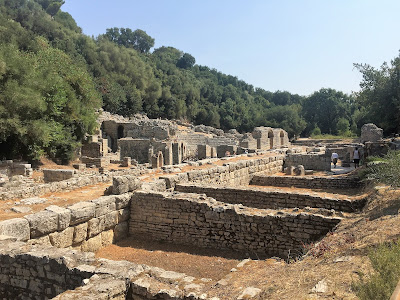
In the vicinity of Sarande there's located an ancient city of Butrint, which is also
a UNESCO World Heritage site. We got there by taxi from Sarande for 2000 LEK, but there's also a bus going there every half an hour (the same which goes to Ksamil).
Butrint was an ancient city throughout Greek, Roman, bishopric and Byzantine periods, and it was abandoned during the Middle Ages. Its most notable remainings are
Roman amphitheater, a Byzantine Basilica, and a Roman temple with mosaic floor.


The next days were very relaxing - we were either chilling out in Sarande or we headed to the nearby sand beach in Ksamil. Well chilling out is maybe not the most appropriate expression as it was apparently the hottest summer in Balkans since many years with the temperatures reaching 38 degress in the shadow.


The beaches in Sarande were very few and the shore were stony, this is why we headed a few time to Ksamil. There was a public bus going there every half an hour, however before it reached our stop, it was already full of people. We then decided to commute by taxis, especially since the drive costed us only 12 euros. Ksamil is a small village, however in summer it becomes a touristy resort - with hundreds of tourists willing to enjoy its beautiful beaches. Beach in Ksamil was really beautiful with its white sand, but very overcrowded. With the limited number of "organized beaches", getting there late - i.e. after 10AM meant that there will be no more sunbeds. But while offering a bribe, an umbrella was quickly found ;-)
Our favorite beach was "Three Islands" which was offering the view on three small islands just a few meters from the coast. It was possible to swim there or get there by a rented sea bike. Water was unbelievably turquoise.


In the vicinity of Sarande there's located an ancient city of Butrint, which is also
a UNESCO World Heritage site. We got there by taxi from Sarande for 2000 LEK, but there's also a bus going there every half an hour (the same which goes to Ksamil).
Butrint was an ancient city throughout Greek, Roman, bishopric and Byzantine periods, and it was abandoned during the Middle Ages. Its most notable remainings are
Roman amphitheater, a Byzantine Basilica, and a Roman temple with mosaic floor.