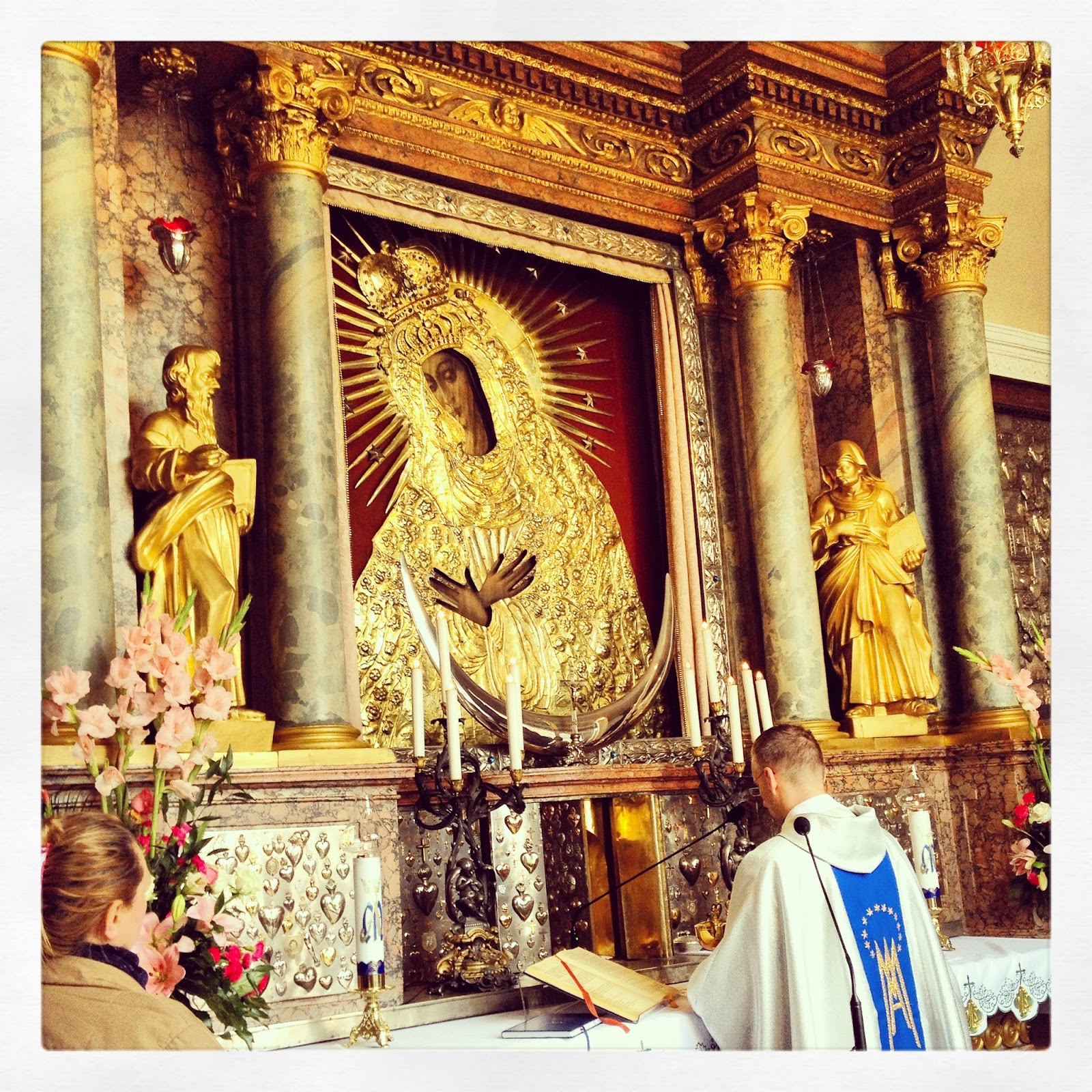
Saturday morning is not easy. My train to Minsk leaves Vilnius at 8:00 AM, but I have to show up earlier in the train station because of the border control. Half asleep, I'm running through the city to the station. There, it turns out that all the procedure goes fast and smoothly. Border guards are located in the underground corridor of the station, which leads to the special platform, from which trains to Belarus depart. Train also turns out to be modern and very fast - the journey takes only 2,5h.
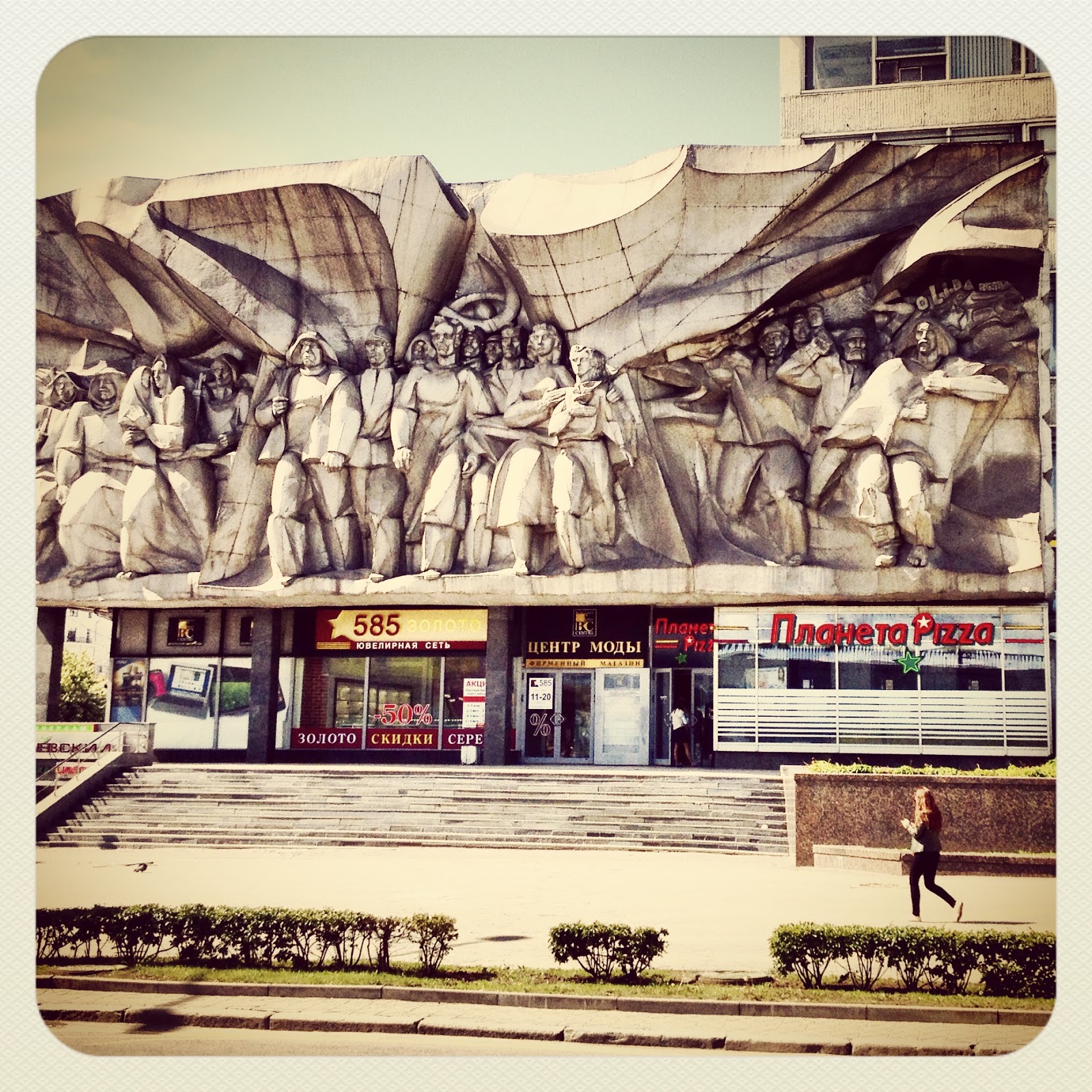
Punctually at 10:30 the train arrives to Minsk. I leave the station and I find myself surrounded by the monumental, terrific Soviet architecture. I'm a bit lost on what to do, as I did not book any accommodation and I don't even have money to buy a metro ticket. I ask a random young guy for directions, and he does not only shows me where to go, but also walk with me 10 minutes, to make sure I'm not lost. I also learn that in a few months he will be studying in Wrocław! :)
On the way, in the park, I see the statue of Adam Mickiewicz :)
Finally I arrived at my destination - hostel Trinity - beautifully located on the Trinity island, 50 metres from the Svislach River (Nemiga Metro Station). The island with its colourful little town houses is like an oasis on the concrete desert. In the hostel I learn that they don't have private rooms, but I'm too tired to look for another accommodation, so I decide to stay in the dorm. Luckily I share it only with one girl.

I leave my luggage and I leave to do some sightseeing - I don't want to loose any precious minute!! I don't see any tourist on the street and interestingly, apparently I seem a local - a least five times people were asking me something, thinking I was Belarusian too. In general people are very friendly and helpful and communication is quite easy - I speak Polish, they speak Russian or Belarusian and we can understand each other somehow. I have though a problem with inscription as everything is written in Cyrillic - which I'm unable to read. But as I wrote above - whenever I'm lost - I ask locals, who will be always ready to help.
At first Minsk seems horrible! Huge, hectic, grey with socrealistic architecture and communist buildings. Nothing to do with lovely Vilnius which I just left. Explanation of that is very simple - Minsk was the third - after Warsaw and Berlin - most destroyed city during the World War II. While the two others were rebuilt, and an effort was made to preserve the remainings of the old buildings, the similar work was never done in the burnt to ashes Minsk. It was built from scratch, according to socialistic planning and Moscow's dictation. Soviet influences are well visible - monumental buildings, wide boulevards and socrealistic architecture.
Victory Square is a very important place in Belarus with a huge obelisk in the centre, and the eternal flame - both being a memorial for those who died in the Great Patriotic War.
Walking in Minsk makes me feel like I'm back in time to the deep communism era. I spot the statues of people who are considered rather controversial figures in the rest of the world, while here they are doing great!
Belarus is the country hosting one of the highest numbers of Lenin's statues (along with Russia and Ukraine).
Also Felix Dzierżynski aka the Iron Felix, creator of Cheka - the security organization known for terror and mass executions in the Soviet Russia - is fine. His statue in Minsk is one of the only remaining monuments in the world.
But although at first Minsk does not seem the be the friendliest and charming city, it has also many of hidden gems.
Island of Tears is 5 minutes away from my hostel. It is a memorial commemorating Soviet soldiers from Belarus who died during the war with Afghanistan. In the centre there
is the chapel, with figures of grieving mothers, widows, sisters and daughters. Inside the names of over 700 Belarusian soldiers who died in the war are
inscribed. A statue of a crying guardian angel overlooks the chapel.
Monument to Fallen Jewish People on March 2, 1942
Gorki Park and the statue of Maxim Gorki (Russian writer)


In the afternoon I meet Nikita and Lena. They bring me to the National Library of Belarus - which contains the largest collection of Belarusian printed materials and the third largest collection of books in Russian.
We go up to the 23rd floor from which we observe panorama of Minsk.
It is also my first encounter with Belarusian cuisine - I go for draniki (potato pancakes or placki ziemniaczane, which we also eat in Poland) with herring.

In the evening I go to the
Yanka Kupała Theatre - the oldest theatre in Belarus, named after one of the greatest Belarusian poets and writers. All the theatre pieces are being displayed in Belarusian, which is rather a rare thing in the Russian speaking Minsk. The irony is that on that evening, the only spectacle is the one of the Russian writer - Nikolai Gogol's - "Christmas Eve". According to my friend - Belarusian and Polish are so similar, that I should not have problems in understanding it. In fact I could not really understand much, but still enjoyed this experience a lot :)
Whenever I travel, I tend to eat only local meals. It turns out not to be the easiest thing, as Belarusian cuisine is composed mainly of meat dishes - which I don't eat. Luckily there are still potatoes, so in the restaurant Kamyanitsa I continue with draniki with caviar, mushroom soup as a starter and kvas to drink :)
How do I spend the very late evening? It is Eurovision night, so I watch the contest among with Belarusians. It is not difficult to notice that they all support Russia.
On Sunday I decided to start my day with fulfilling my civil duties - on that day Poles voted for the president of Poland, so did I - in the Embassy of Poland in Minsk :)
My next point is Belarusian State Museum of the Great Patriotic War. It contains a big collection of objects related to the WW2 (which for this part of Europe concerns years 1941-45), and apparently it is one of the largest war museums in the world. I'm very interested in history, and I always visit historical sites or museums, however I have my doubts whether the past was presented objectively in this one... Well rather Soviet style propaganda. Still the ticket was very cheap, and some of the exhibitions very interesting, so I recommend visiting this place.

In the afternoon I continue visiting the city. It is not always easy, as the distances are really huge, I feel like I walked at least 20 km during the weekend!
Holy Spirit Cathedral

In the evening I went to the National Opera and Ballet Theatre of Belarus to see Aida by Verdi. Spectacular building as seen from the outside, and great, classical performance of the opera.
I had two remarks after this evening - first of all it seems that opera is highly popular in Belarus - old, young, children, entire families, reach, poor - all society's classes were represented that evening. Second observation that unlike in Western countries when during a break people choose to drink wine or bubbles, here everyone was ordering a tea and a cake :)
Last morning I spent on buying some souvenirs. On the Trinity Island itself, there are two great shops with folk art.

On the way back to Vilnius, I met a young man who - when he learns I'm Polish - thanks a lot my country for supporting Belarusian opposition, for financing opposition radio and television, for establishing the Belarusian University in Poland. When he learns that I live and work in Brussels, he expresses his hopes that Belarus becomes one day part of the European family... He also told me that his children were going to the underground school in order to be able to study in Belarusian (which apparently is not allowed in Belarus).
He was coming from Brest - a city which used to belong to Poland prior to the WW2 and which is located now at the border with Poland - but of course on the Belarusian side.
I couldn't help by wonder what if in 1945 - at some higher political level - a decision was taken that Brest remained Polish. How different the life of this young man would have been. How unpredictable human paths are, that a few kilometres away from each other, on both sides of the border, people lead completely different lives. In the moments like this I can only appreciate how lucky I am that - although not born in a free country (Poland was under Soviet's Union influence back then) - I was growing in a country that managed to unleash from its "older brother", where I could speak my language freely, decide on my own and not being prosecuted for different political opinions.
This man - trying to keep his Belarusian roots and the language - was rather an exception though. After my very short observation of Minsk streets and people, I could notice that most citizens do not want to provoke the regime, are happy to be close to Russia and they speak mostly Russian. Belarusian language is disappearing, and the public display of the pre-1994 Belarusian flag could lead to an imprisonment. Most people seem to neglect and forget their language (very little people in Minsk were able to speak Belarusian) and their past, and are satisfied with becoming Russia's satellite rather than being an independent being. Of course, it is not easy to fight against dictator - Lukashenko regime keeps on suppressing the opposition, but still I have impression that other nations such as e.g. Poles or Lithuanians never gave up, while a major part of Belarusians seem reconciled to this situation.